Press "Enter" to skip to content

Tag: Bernard Madden

Co-Process Volume 3

“The way different people have come to the same discovery independently,” wrote William H. Whyte in his 1956 book The Organization Man, “refutes the ‘great-man’ concept we cherish. It’s mostly luck who makes a discovery. If there had been no Einstein there would, in all likelihood, still be a relativity theory.”

Over the past several years, Suss Müsik has enjoyed a fruitful collaboration with visual artist B.G. Madden. Madden’s work explores unresolved systems in environmental surroundings, revealing hidden relationships between the natural world and the structures humans impose upon it.

The very first collaboration emerged in 2018, near the close of Suss Müsik’s bombastic “fake orchestra” phase. A pigmented photograph by Madden was digitally rendered into instrumental fields as a form of graphic notation. The result could retrospectively be considered a transitional piece.

Later works dispensed with “instruments” in favor of a more abstract sonic palette. Madden’s images were scanned using a computer algorithm to produce blobs of indecipherable static. These raw artifacts were made more “musical” by identifying tones that fit neatly into major pentatonic (five-tone) scales in D# and F# keys. What emerged was a rich library of material that could be manipulated into a number of fascinating juxtapositions. One piece from this period was named after the astronomer Jan Oort, who discovered a sphere of icy objects at the edge of our solar system from which comets are believed to originate.

Another piece, titled Domus, was inspired by the sculpture of Richard Serra and the architecture of Tadeo Ando. The piece recalls the brute aesthetic of each artist, bringing to mind delicate patterns of ever-shifting light and sound.

The collaboration continued during pandemic conditions in 2020. Madden mailed Suss Müsik a number of handmade index cards on fine art paper. These strange works in graphite and collage felt almost like automatic writing, perhaps a way to translate the isolation of that period into a visual language. Or it may have been the a furthering of the Serra/Ando influence; on Madden’s studio wall was a sign written in huge letters: “NOT AN ILLUSTRATION.” Perhaps this was a way to transform an imaginary state to reality, in any event, Suss Müsik interpreted these works in the form of clicks, beeps, and static grit.

These explorations were compiled into two volumes, both titled Co-Process, which to this date represent the most popular Suss Müsik releases on Spotify.

A third volume has now emerged, coincidentally titled Co-Process Volume 3. This new body of work reflects a slightly different approach. Madden’s works have become less structural and more symbolic, their imagery operating almost as a simulacra. Line drawings of ceramic vases, heads of statues, and ancient artifacts bring to mind treasures excavated from an imaginary archaeological site.

artwork by B.G. Madden, several line drawings of vases and heads

The drawings gain a peculiar resonance when coupled against a grid system of blocks, dots, and lines. And within this strange universe of configurations resides what appears to be a xeroxed photograph of a young skateboarder, perhaps representing some sort of past-present boundary.
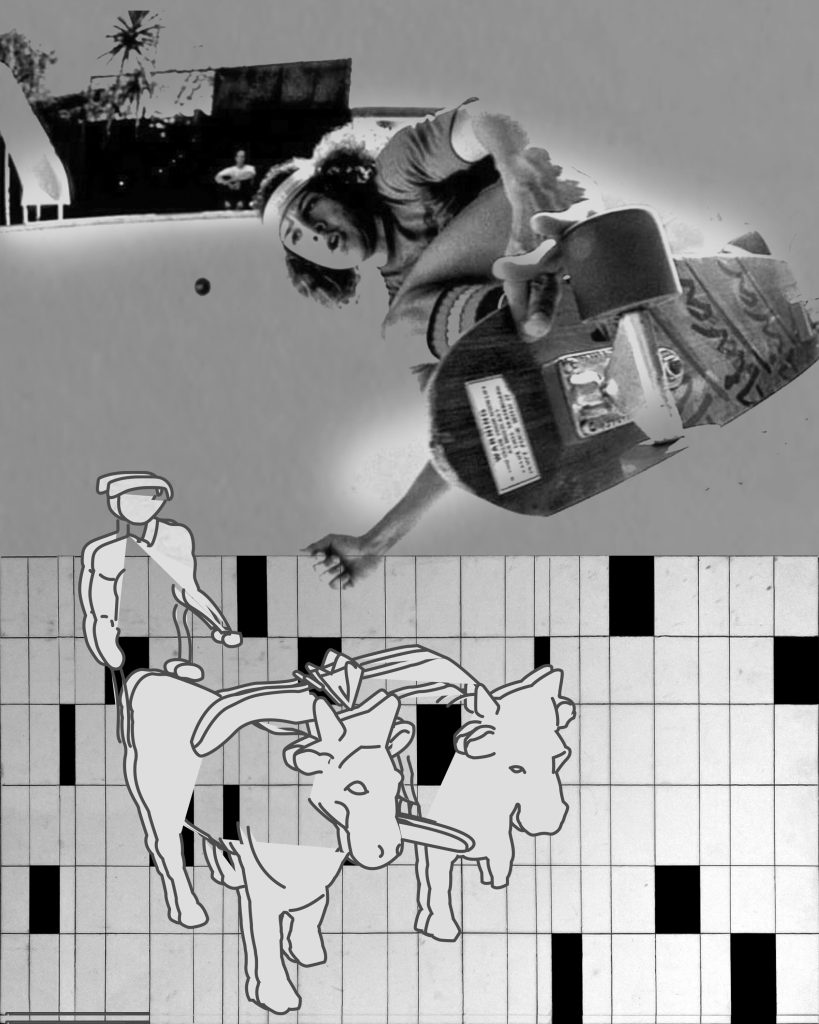
artwork by B.G. Madden, skateboarder with line drawing of farmer against a grid

artwork by B.G. Madden, drawn head against a grid background

Suss Müsik scanned Madden’s artworks, just as before, but given the comparatively more figurative aspects of this work it was clear that something else was needed.

Noting the similarity in patterns with the keys of a piano and digital sequencing software, Madden’s abstracted grids resembled a chord structure and melodic progression. Eight chord sequences formed the spine of several new compositions, sometimes broken out into arpeggios and sometimes played straight. The progression were then played using a combination of traditional (piano, percussion, fake strings) and handmade electronic instrumentation.

artwork by B.G. Madden, several dots and lines sketches

After several rounds of demos were reviewed by both artists, Suss Müsik recorded the best six pieces live to 8-track in a single weekend. This work comprises what the listener hears when experiencing Co-Process Volume 3.

Leave a Comment

So Many Releases

Suss Müsik has been busy in 2025, apparently too busy to update this website.

First came the release of CCEP in January: four brief songs we’re calling “robot folk,” performed on a hacked MIDI guitar and handmade glitch devices. The pieces were recorded live to 8-track over the course of several weekends. If you love the guitar music of Fred Frith and Eugene Chadbourne, you might tolerate this.

CC EP album cover art

That was followed by Microcosms, an equally brief but different experiment in fractal sonic geometry. It was also recorded live to 8-track, using handmade equipment and hacked software. Probably too difficult for most tastes, but it may twirl a lobe or two.

Microcosms album cover art

Last but certainly not least: April saw the release of Co-Process Volume 3, the third in a series of sonic collaborations between Suss Müsik and visual artist B.G. Madden. Madden’s artworks were scanned to create eight chords that were performed with various instrumental “voices.” The notes from each chord were then refactored into sequenced arpeggios; these form the overall compositional structure of each piece. Each of the six pieces was performed using a combination of traditional and handmade electronic instrumentation. A longer post on this work is upcoming.

Co-Process Volume 3 album cover art

All three releases are available for listen or purchase on Bandcamp:

Leave a Comment

DIY Synths, Artiphon Attachments, and “Dovum” Live

Suss Müsik built upon the Artiphon INSTRUMENT-1 with a DIY synth attachment, played via touch-sensitive ring with built-in modulation. DIY synths are fun.

The first demo is a little improvisation with fake strings played on the Arti as fingered chords, with sustain/pressure variances controlled by footpedals. Sound is generated on the synth by gliding one or two fingers along the outer ring.

The second is a live performance of Dovum, a piece built around audio scans of B.G. Madden’s artwork.

The added text is the first paragraph of Oku no Hosomichi (meaning “Narrow Road to Oku”), a 1702 work written by Matsuo Bashō. Translated to English, the text reads as follows:

“The months and days are the travelers of eternity. The years that come and go are also voyagers. Those who float away their lives on ships or who grow old leading horses are forever journeying, and their homes are wherever their travels take them.”

The Quarantine Concert series shall continue for as long as the pandemic does.

Leave a Comment

Co-Process Volume 2 Released

Co-Process Volume 2 coverSuss Müsik amassed enough decent material from the latest collaborations with artist B.G. Madden to put out a proper release. Co-Process Volume 2 continues the path forged by Co-Process released earlier this year. It’s all glitchy, droney, ambient weirdness. Sound was created from audio scans of Madden’s visual art, which was provided in the form of postcards delivered via US mail. (These quarantine days necessitate drastic creative measures). The scans were then manipulated using all sorts of technical gadgets, from grain synthesizers to DIY electronic devices. The album is available on Bandcamp, and more of Madden’s beautiful artwork can be seen here.

Leave a Comment

More Collaborations with Artist B.G. Madden

Over the past year, Suss Müsik has enjoyed working with visual artist B.G. Madden on a series of art/sound collaborations. One piece explores system in nature to reveal hidden relationships between the natural world and synthetic technology. Another piece uses Madden’s work as graphic notation, rendering pigment and plaster into polyrhythmic fields.

This partnership has produced three new pieces built almost entirely from audio scans of Madden’s newest work: a series of open compositions inspired by the sculpture of Richard Serra and the architecture of Tadeo Ando. Both of these visionaries transform the brute aesthetic of their chosen materials into delicate studies of ever-shifting light.

Suss Müsik sought to accomplish a similar synthesis in sound. Madden’s work was scanned using a computer algorithm. These unendurable blobs of static were processed in real time using the major pentatonic (five-tone) scale in keys of D# and F#. The process resulted in a rich library of sonic overlaps.

The first piece, titled Montessori, combines two dissonant (yet seductive) surface textures to form an engagingly simple configuration of glitchy ambience:

The second piece, titled Corbusier, references building architecture less subtly in both its title and single-chord scaffolding. The title is derived by the educational approach that focuses on behavioral observation:

The third piece, titled Dovum, was created from Madden’s more Jan Dibbets-inspired work. The title is a mashup of the words doven (prayers recited in a Jewish liturgy) and ovum (a cell that reproduces when fertilized by its counterpart):

Marc Weidenbaum of Disquiet wrote a very kind analysis of Dovum that beautifully sums up what Suss Müsik has been trying to achieve since 2015: “a digital purity of sound that is employed to present materials whose cumulative chaos strives to approach that of the natural, analog, flesh-and-blood world.” Thank you, Marc.

The entire B.G. Madden collaboration is available for listening on SoundCloud. Discussions are underway to release a proper album and play some live dates. Stay tuned.

Update = Yet another new collaboration has arisen. The piece is titled Oort, named after astronomer Jan Oort who discovered a sphere of icy objects at the edge of our solar system and from which comets are believed to originate.

Original graphite works by B.G. Madden are shown below:

Art 1 by B.G. Madden

Art by B.G. Madden

Art 3 by B.G. Madden

Leave a Comment