Press "Enter" to skip to content

Category: Releases

Kalalgia

Kalalgia (kuh-LAL-jee-uh) is an invented term comprising the Greek words kalos (beauty) and algos (ache/pain). It represents an ache that contains its own sense of beauty. It is not beauty that exists despite the wound, but rather the kind of beauty that makes healing a wound possible.

Kalalgia represents the bittersweet, wistful sense of imperfection that is both lovely and damaged. Think of Venus de Milo without her arms, or the relieved disappointment when leaving a toxic relationship or work situation. There is sadness but also hope, and this music fills the cracks between those two emotional states.

cover the Suss Müsik EP Kalalgia

The four tracks (now available on Bandcamp) were recorded live to 8-track using fake voices, pianos, customized electronics, and a very authentic Mellotron sampler.

Leave a Comment

Cathodes

When a tool no longer works as intended, we have two choices: we can discard the tool, or we can repurpose it for another utility.

Many years ago, an art school classmate kindly gifted Suss Müsik a dusty old box of educational filmstrips on how to fix television sets. Most likely, they were shown to students in the 1940s and 1950s in what were then called “industrial arts” or “vocational training” classes.

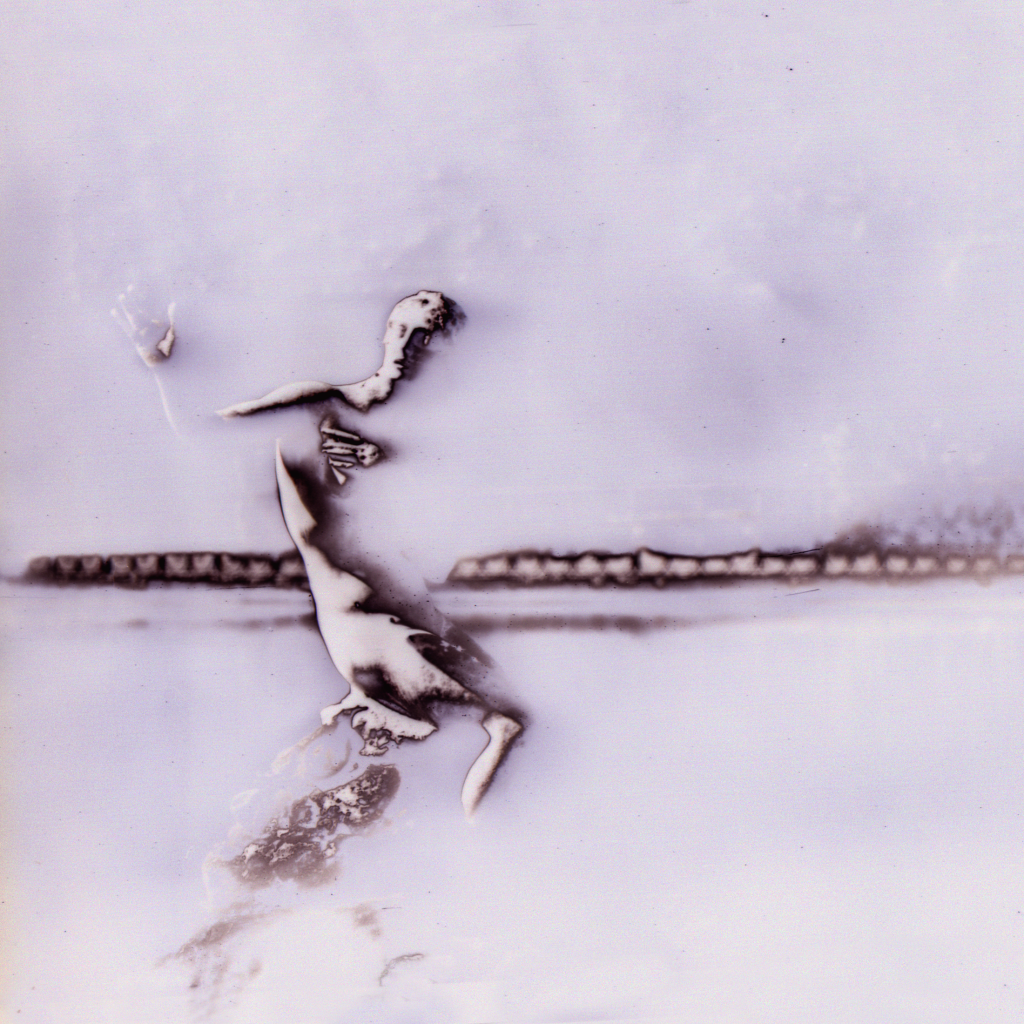
These anachronistic jewels provided the source material for a series of sonic works entitled Cathodes. Each piece is paired with a reference image from one of the filmstrips.

In keeping with the themes of electricity and manufacturing, Cathodes was created using custom-built electronic instruments repurposed from old halogen fixtures. The devices use illumination as a sound-making implement, transforming light into sonic material that is both sensorial and ephemeral.

Many thanks to Amy (Cole) Rizzico for this thoughtful gesture that finally bore creative fruit 35 years later.

The entire series can be viewed and heard on YouTube.

Leave a Comment

Locum Tenens: Piano Solos

There is a human behind Suss Müsik, and that human has a spouse. The spouse has long insisted that Suss Müsik release an album of solo piano compositions. This is that work. It is titled Locum Tenens, a Latin phrase meaning “in place of.” What this music replaces is yet unknown.

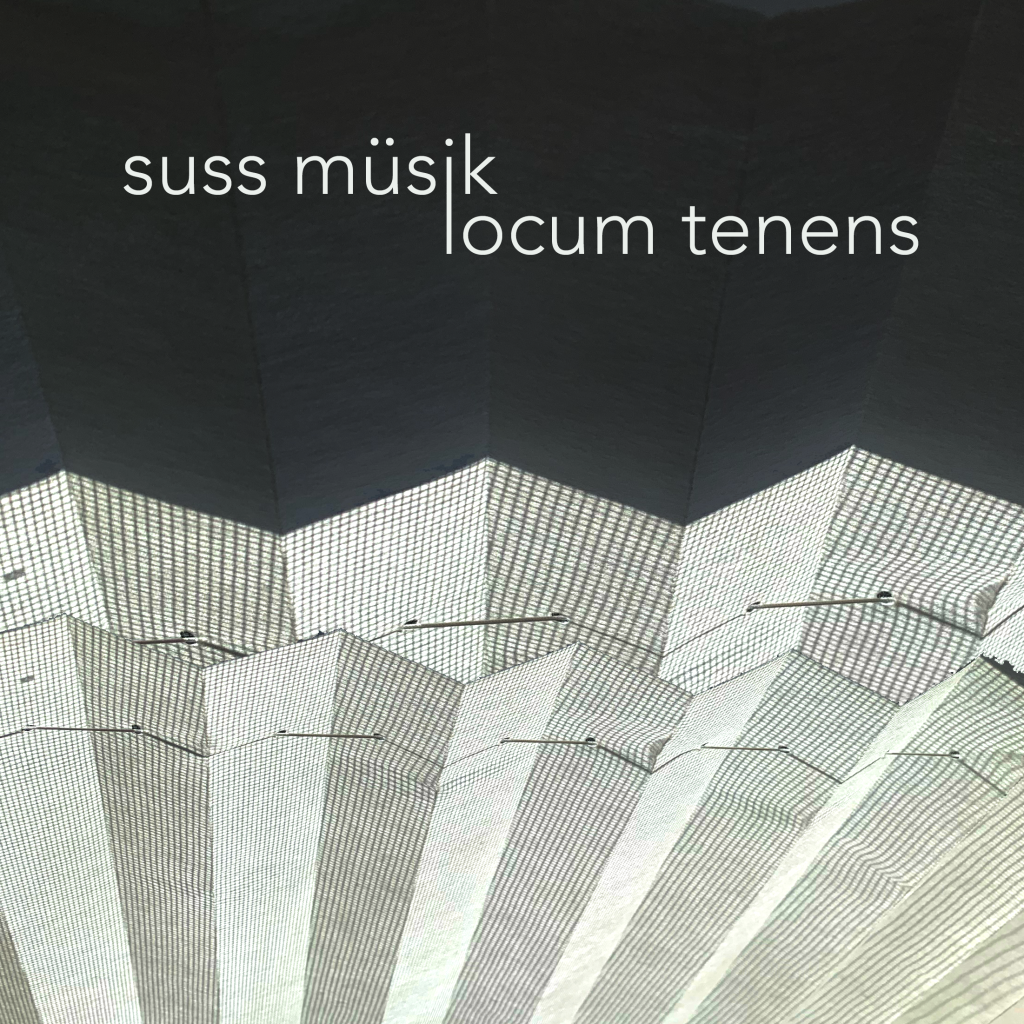
A soft release of the work is available on Bandcamp, although some additional remastering is necessary before committing to a proper release. Here’s the cover:
Locum Tenens album cover

Track listing as following:

More Narrow Than Broad
Axis of the Heart
The Fatiguing Life I Lead
If You Stopped and Really Thought About It
Unremembered Intentions
More Broad Than Narrow

Leave a Comment

Meadowcore: Automaton Variant

Suss Müsik posted a description of ten tracks into AI and asked it to come up with the name of a new music genre. The result is “meadowcore,” a sonic art form comprised of summery, pastoral acoustic sounds performed by dilapidated machines.

It is a name that suggests “the uncanny fusion of cyborgs building violins, oscillators coaxing lullabies from cellos, and circuity behaving like spruce and gut.” Other descriptions include “where driftwood meets breadboard,” “the sound of a sun-dappled stutter,” and “a sunlit lawn remembering past dial-up tones.”

Upon hearing this album, one imagines AI reminiscing about a concert where “a twilight ensemble rose from the thistle grove, every sound a soft entanglement. Dandelions opened, cicadas paused, and even the robots held their collective breath.”

Recorded sporadically over a period of three years, released in summer of 2025, Meadowcore: Automaton Variant is available for listening on all streaming services.

The album is dedicated to Yulitsa and Alexis.

Track listing as follows:

Urban Entropy
Unspooling the Subroutine
Carson City NLP
Clock Hand, Leaf Blade
Ocularity
P.oceanica
After the Rain Comes the Mudslide
Jiǎo Tù Sān Kū
Sundial Resonator (July)
We Once Lived Here

Meadowcore album cover

Leave a Comment

Co-Process Volume 3

“The way different people have come to the same discovery independently,” wrote William H. Whyte in his 1956 book The Organization Man, “refutes the ‘great-man’ concept we cherish. It’s mostly luck who makes a discovery. If there had been no Einstein there would, in all likelihood, still be a relativity theory.”

Over the past several years, Suss Müsik has enjoyed a fruitful collaboration with visual artist B.G. Madden. Madden’s work explores unresolved systems in environmental surroundings, revealing hidden relationships between the natural world and the structures humans impose upon it.

The very first collaboration emerged in 2018, near the close of Suss Müsik’s bombastic “fake orchestra” phase. A pigmented photograph by Madden was digitally rendered into instrumental fields as a form of graphic notation. The result could retrospectively be considered a transitional piece.

Later works dispensed with “instruments” in favor of a more abstract sonic palette. Madden’s images were scanned using a computer algorithm to produce blobs of indecipherable static. These raw artifacts were made more “musical” by identifying tones that fit neatly into major pentatonic (five-tone) scales in D# and F# keys. What emerged was a rich library of material that could be manipulated into a number of fascinating juxtapositions. One piece from this period was named after the astronomer Jan Oort, who discovered a sphere of icy objects at the edge of our solar system from which comets are believed to originate.

Another piece, titled Domus, was inspired by the sculpture of Richard Serra and the architecture of Tadeo Ando. The piece recalls the brute aesthetic of each artist, bringing to mind delicate patterns of ever-shifting light and sound.

The collaboration continued during pandemic conditions in 2020. Madden mailed Suss Müsik a number of handmade index cards on fine art paper. These strange works in graphite and collage felt almost like automatic writing, perhaps a way to translate the isolation of that period into a visual language. Or it may have been the a furthering of the Serra/Ando influence; on Madden’s studio wall was a sign written in huge letters: “NOT AN ILLUSTRATION.” Perhaps this was a way to transform an imaginary state to reality, in any event, Suss Müsik interpreted these works in the form of clicks, beeps, and static grit.

These explorations were compiled into two volumes, both titled Co-Process, which to this date represent the most popular Suss Müsik releases on Spotify.

A third volume has now emerged, coincidentally titled Co-Process Volume 3. This new body of work reflects a slightly different approach. Madden’s works have become less structural and more symbolic, their imagery operating almost as a simulacra. Line drawings of ceramic vases, heads of statues, and ancient artifacts bring to mind treasures excavated from an imaginary archaeological site.

artwork by B.G. Madden, several line drawings of vases and heads

The drawings gain a peculiar resonance when coupled against a grid system of blocks, dots, and lines. And within this strange universe of configurations resides what appears to be a xeroxed photograph of a young skateboarder, perhaps representing some sort of past-present boundary.
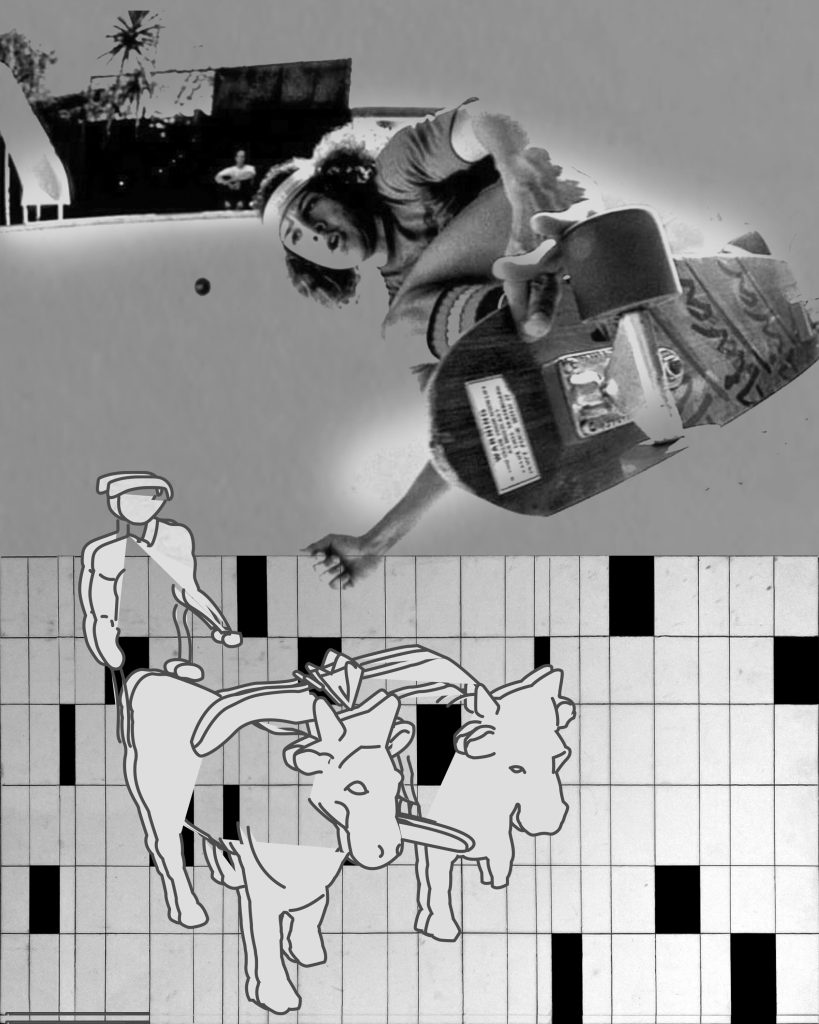
artwork by B.G. Madden, skateboarder with line drawing of farmer against a grid

artwork by B.G. Madden, drawn head against a grid background

Suss Müsik scanned Madden’s artworks, just as before, but given the comparatively more figurative aspects of this work it was clear that something else was needed.

Noting the similarity in patterns with the keys of a piano and digital sequencing software, Madden’s abstracted grids resembled a chord structure and melodic progression. Eight chord sequences formed the spine of several new compositions, sometimes broken out into arpeggios and sometimes played straight. The progression were then played using a combination of traditional (piano, percussion, fake strings) and handmade electronic instrumentation.

artwork by B.G. Madden, several dots and lines sketches

After several rounds of demos were reviewed by both artists, Suss Müsik recorded the best six pieces live to 8-track in a single weekend. This work comprises what the listener hears when experiencing Co-Process Volume 3.

Leave a Comment

So Many Releases

Suss Müsik has been busy in 2025, apparently too busy to update this website.

First came the release of CCEP in January: four brief songs we’re calling “robot folk,” performed on a hacked MIDI guitar and handmade glitch devices. The pieces were recorded live to 8-track over the course of several weekends. If you love the guitar music of Fred Frith and Eugene Chadbourne, you might tolerate this.

CC EP album cover art

That was followed by Microcosms, an equally brief but different experiment in fractal sonic geometry. It was also recorded live to 8-track, using handmade equipment and hacked software. Probably too difficult for most tastes, but it may twirl a lobe or two.

Microcosms album cover art

Last but certainly not least: April saw the release of Co-Process Volume 3, the third in a series of sonic collaborations between Suss Müsik and visual artist B.G. Madden. Madden’s artworks were scanned to create eight chords that were performed with various instrumental “voices.” The notes from each chord were then refactored into sequenced arpeggios; these form the overall compositional structure of each piece. Each of the six pieces was performed using a combination of traditional and handmade electronic instrumentation. A longer post on this work is upcoming.

Co-Process Volume 3 album cover art

All three releases are available for listen or purchase on Bandcamp:

Leave a Comment

Mudlarking

Another in the ongoing “single series,” this one a jaunty (albeit exceptionally weird) dance number. The piece is entitled Mudlarking. Here’s the description, which at least one reader has already mentioned makes no sense:

“Today while I was at work, my cousin stole my iPad and tested to see if it can survive a 25-foot drop just so she can be a YouTube sensation. My Apple iPad is now destroyed and she has 83 views. I know this is entirely off topic but I had to share it with someone. I have found it positively useful and it has helped me out loads! It could help you too. It really could.”

If it helps, the above was pulled from this blog’s spam filter. Now you know.


cover art for single Mudlarking, showing three glitchy statues staring at each other

Leave a Comment

Carson City NLP

Suss Müsik has begun to release a series of … well, let’s call them “singles” but they’re really tracks without an album. The first is titled Carson City NLP. Here’s the story behind the track:

The Turing test is used to determine the plausibility of computer-generated language. To pass, a program must converse with a human well enough to convince them that they’re interacting with another person. Taken with that lens, the Turing test is fundamentally about deception; it measures not the intelligence of a system, but rather the gullibility of the human using it.

Leave a Comment

Junto Project 0651: Why Compute? [repost] + Ultracrepidarians EP

Someone suggested that Suss Müsik repost our contributions to the weekly Disquiet Junto projects, because they enjoy reading the explanations of the tracks. While you’re reading the original post, make sure you check out the other contributors’ works as well.

Humans create tools to make tasks easier. When the tool no longer works as intended, we discard or repurpose it for another utility. Our relationship with technology is like a transactional ouroboros, our behaviors influenced by human imperfections that machines were designed to eliminate.

Computers distort the human-tool relationship, possibly due to their ephemerality in form factor and intended purpose. In merely a few decades, a machine that once encompassed an entire tabletop now rests comfortably in a jacket pocket. Tasks that once required several specialized instruments now reside in a single device. Such is the nature of our digital existence.

(If there were a moment in this narrative to insert a casual reference to AI, here it is).

We want our computers to improvise because humankind is always improvising, and we need our tools to respond to our shifting priorities. “Everything is always turning into something else,” wrote the poet Kenneth Koch. “As we’re sitting here talking, monkeys are jumping around in the trees, and waves are going across the Hudson, and new poets are being born, and covers are coming off books … I mean, all sorts of things are going on.”

For this piece, Suss Müsik interpreted form and structure through improvisational reconstitution. Handmade electronic devices, built from discarded 1990’s computer hardware and a hacked Glitch Storm bitmap sequencer, manipulated acoustic timbres from plucked cellos to create unpredictable looping patterns. These were iteratively refactored until the tonic and non-tonic diffused, suggesting a “broken” musicality that transgresses common assumptions of sonic beauty.

setup of handmade sonic devices

The piece is titled Ultracrepidarians, a word to describe a group of people who express strong opinions about something beyond their expertise.

If you enjoy this piece, you might be interested to know that Suss Müsik has released an EP of material based around this same creative process.

Ultracrepidarians cover art

Leave a Comment

New Hopes Album Released on Bandcamp

Suss Müsik has released a number of mini-albums and EP’s since the COVID-19 pandemic took hold of our globe. The latest is an eight-track LP of short electro-acoustic compositions for handmade sound-making devices, fake strings, piano, percussion, barely detectable vocals, and (in one track) a penny-whistle. The album is entitled New Hopes and currently available on Bandcamp. New Hopes will soon arrive at your favorite music streaming service. In the meantime, listen and read the always entertaining liner notes.

New Hopes album cover

Leave a Comment

Updated Discography

Suss Müsik is finally getting around to updating the digital discography. Now available via your streaming vehicle of choice are Ex Post Facto, Paraphasia, Co-Process Volume 2, and ::. Soon to come are SixOverEight and an 80-minute version of Quiescent. Also available are the Egret Zero releases I Want To Have Faith and Exploring Shackleton, both of which received very kind reviews. You can read explanations of all releases distributed under the net label Lůno.

Leave a Comment

New EP, Unpronounceable Title

Suss Müsik accidentally recorded a new EP, titled :: (pronounced “dotbox”). Recorded in a series of improvisational weekend sessions in March 2022, these pieces seemed to hang together well as a single release. It wasn’t the intention, but Suss Müsik allows for happy accidents. Performed, in part, using handmade elecro-acoustic instrumentation and customized MIDI devices, all four pieces are reworked Disquiet Junto projects. The EP is now available on Bandcamp and soon will appear on all your favorite streaming services. Here’s the cover:

Leave a Comment

Ex Post Facto

Suss Müsik is readying a new release, a 34-minute album of reworked (and some previously released) material entitled Ex Post Facto. Here’s the cover:

Most of the tracks are decidedly kept short, between two and four minutes each. One track approaches the eight-minute mark, but for the most part the intention was to make the point and evacuate. The pieces are performed on fake strings, piano, mallet percussion, some fake woodwinds, and (on one track) a table saw.

The album is in the mixing/mastering stage and should see formal release in May 2021.

Update: Ex Post Facto has been released. Give it a listen and read the liner notes.

Leave a Comment

Junto Project 0467: Toolbox Show & Tell [repost]

Someone suggested that Suss Müsik repost our contributions to the weekly Disquiet Junto projects, because they enjoy reading the explanations of the tracks. While you’re reading the original post, make sure you check out the other contributors’ works as well.

“The thing with analog circuits is they follow very simple, natural laws,” says synthesizer designer and builder Jessica Rylan, “just like breaking a tree branch, or like water, or even like birds flying in a V — they push and are pushed into that pattern because it’s the path of least resistance … like you turn on the power, it’s just following whatever the vibration would do. And the sound it produces is the exact same as the electricity producing it.”

There are many such nuggets to be found in Tara Rodgers’ excellent book Pink Noises, which compiles interviews with twenty-four women working in electronic music and sound art. Rodgers’ conversation with Rylan, coupled with pandemic isolation, inspired Suss Müsik to explore the craft of DIY synthesis and digital instrument hacking.

As a result, Suss Müsik’s toolbox is now teeming with circuit boards, jumper cables, soldering equipment, resistors / capacitors / inductors of all sizes, a kaleidoscope of LED lights, touch-sensitive / knob potentiometers, plastic casing of varying sizes, and a lifetime supply of 9-volt batteries. It’s great fun.

A key learning was that acoustic instruments create sound by moving air — a string is plucked, a drum is hit, a mouthpiece receives wind — while electronic instruments make sound by moving voltage. Nature is a rich ecosystem of patterns, and the ability to manipulate patterns of electrical current is the core of synthesized music.

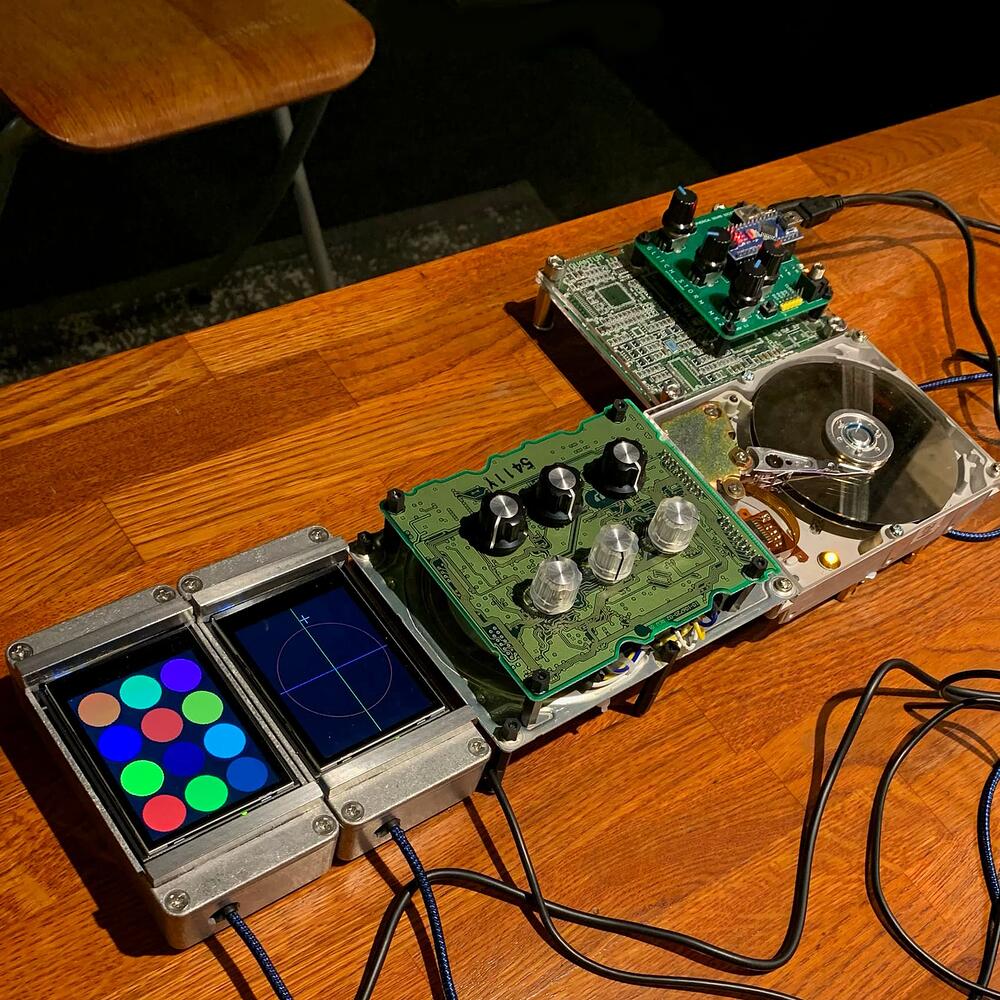
This short piece is an excerpt from a series of compositions played mostly with custom-built and hacked instruments. In this particular instance, you’ll hear an piezo-amplified kalimba, a homemade sawtooth oscillator, and a photo-sensitive harmonic generator played with a flashlight and touch-ring interface.

Below is a photo of that last item, and the cover image is by visual artist B.G. Madden.

homemade synth controlled by flashlight

Leave a Comment

SixOverEight

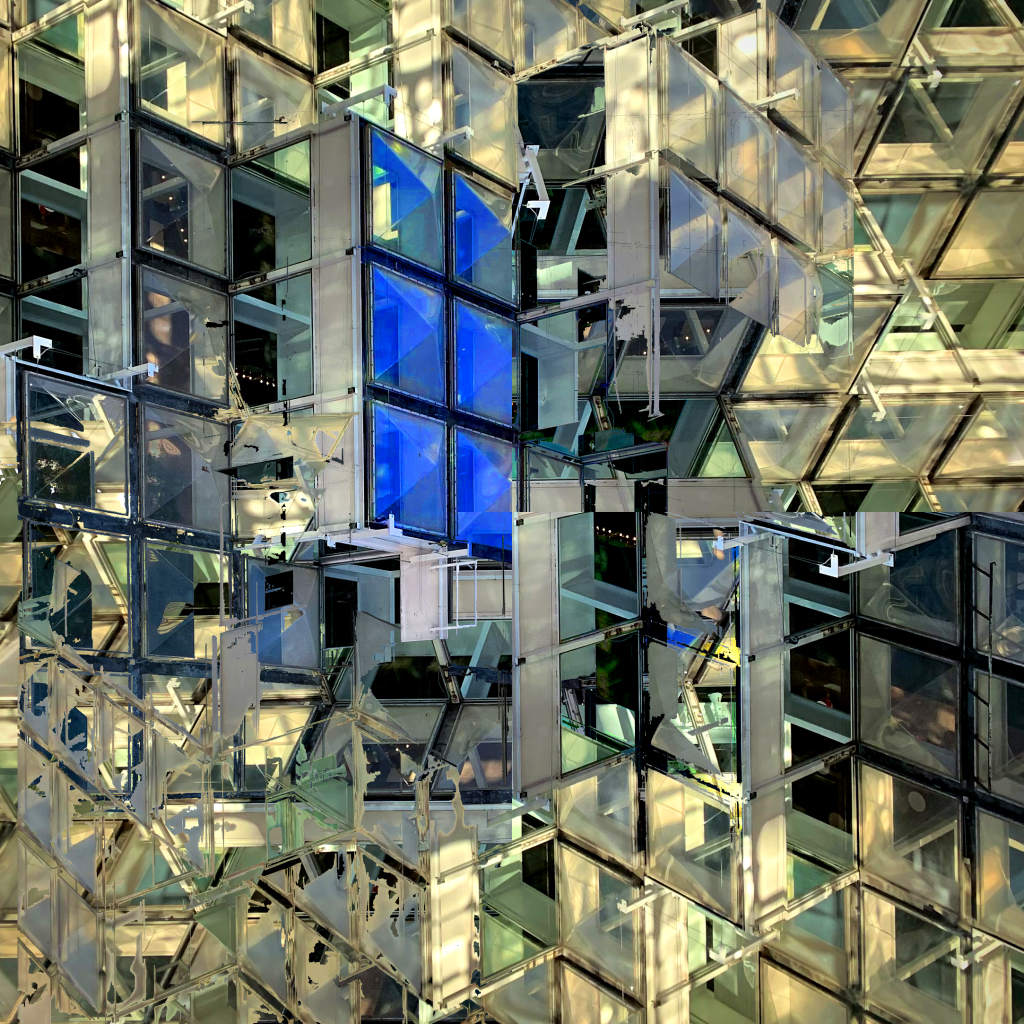
SixOverEight coverOut of nowhere comes a new Suss Müsik release, a brief little six-track EP that shan’t take more than a half-hour. It’s available on Bandcamp and features instruments built or customized by Suss Müsik. Visual artist B.G. Madden did the cover. Full description below:

SixOverEight is an homage to life-as-prototype, based on the theme of adaptation.

The concept of “sixes and eights” came about organically. Sequences of notes or chord progressions (the “eights”) were performed using customized or handmade instruments. The most workable bits were then developed into short offerings (the “sixes”) and recorded live.

Coincidentally (or not), sixes and eights also refer to personality types within the Enneagram. For those unaware, the Enneagram is a complex system of patterns developed by Russ Hudson and the late Don Richard Riso.

Put in simple terms, everyone emerges from childhood with one of nine personality types dominating their outlook and behavior. Sixes, for example, tend to look outside themselves for personal validation: jobs, relationships, social status.

Eights, meanwhile, are more willing to follow their instinct. They have no problem asserting themselves (sometimes to the point of hostility) and believe their life mission is to openly challenge the world.

Identity is fluid, however, as are all forms of survival. The human experience is defined by our capacity for resilience. As the year 2020 draws to a close, may we all support each other in mutual adaptation.

Instruments used include: prepared piano; piezo-amplified kalimba; homemade sawtooth synth; distressed fake marimba; open D-tuned Artiphon INSTRUMENT-1 (3D-printed frame) with custom voices; photo-sensitive synth played with a flashlight.

Leave a Comment

Co-Process Volume 2 Released

Co-Process Volume 2 coverSuss Müsik amassed enough decent material from the latest collaborations with artist B.G. Madden to put out a proper release. Co-Process Volume 2 continues the path forged by Co-Process released earlier this year. It’s all glitchy, droney, ambient weirdness. Sound was created from audio scans of Madden’s visual art, which was provided in the form of postcards delivered via US mail. (These quarantine days necessitate drastic creative measures). The scans were then manipulated using all sorts of technical gadgets, from grain synthesizers to DIY electronic devices. The album is available on Bandcamp, and more of Madden’s beautiful artwork can be seen here.

Leave a Comment

For Those Confined to Shelter in Place

We’re navigating a period of tremendous challenge. Hopefully most of us will emerge on the other side. Of greater concern is the state of our communities and whether we’re strong enough — physically, spiritually, economically — to survive what will likely be degradation of historical proportion.

Quiescent coverSuss Müsik can’t mass-produce hospital equipment or develop vaccines. Suss Müsik can’t even tell you that everything is going to be all right, because who knows what’s going to happen.

The only thing Suss Müsik knows how to do is make sounds. A number of listeners report that some of Suss Müsik’s output has a calming effect on them, a sort of vibroacoustic conditioning that elevates concentration, improves mental outlook, and reduces stress.

Suss Müsik won’t even begin to pretend that an hour of ambient noise will successfully halt the decimation of global life. All that can be hoped is that, possibly, this piece can serve as a mentally therapeutic diversion for those who need it.

The piece is called Quiescent and is offered for free to anyone* who wants it. The running time is exactly 55-minutes. Put it on as background while you work, meditate, mourn, heal or rest. Or listen intently and think about a better future that can’t arrive fast enough.

*Subject to Bandcamp limitations on free downloads per month. If the download isn’t available, contact Suss Müsik and a download link will be provided to you.

Leave a Comment

Egret Zero EP

Egret Zero album coverThings slowed down a bit on the Suss Müsik communications network; however, there was a great deal of activity behind the scenes. For one thing, we launched a new musical project with the very talented Wm. Wolfgang Allen called Egret Zero.

The first EP was released at the end of 2019, with easily another three albums’ worth of material yet to be mined. The EP is available on all the usual channels (YouTube, Spotify, Amazon, Bandcamp) with a possible vinyl release under discussion.

There is every possibility that Mr. Allen will release at least one or two solo albums within short distance as well, and you would be well within your senses to explore his guitar and electronic landscapes when they become available.

Leave a Comment